Sunday, September 13, 2009

Brain Rules - John Medina (part 2)


Rule 3 - Wiring
Our learning process is determined by neurons, whose connections engorge and/or re-route based on our experience.
The brain's wiring is determined by both a experience independent factor and the experience dependent. While the experience independent is the the type of wiring that we all undergo based on our common experience (walking, balance, breathing, etc), the experience dependent is obviously dependent on what our life experiences have been. For example, a violinist will have a different brain wiring to that of a mathmatician.

Apparently, the information on the brain is stored in certain actual physical locations, and what is even more interesting is that this information is stored in different places of the brain for each person. In fact, apparently one could predict how developed certain knowledge or skill is capable of being based on the place where the information is stored in the brain of the individual. Moreover, this doesn't change with age, so once we store something in certain part of our brain, we'll keep it there forever.

Another interesting point of the chapter is that most of the brain wiring happens in two particular ocassions: early childhood and puberty. It's up until the early 20's that we continue developing neurons and re-wiring our brain, although some more activity happens till the mid 40s.

Rule 4 - Attention
There wasn't really too much interesting in this chapter, but here are some notes
Attention is driven by three things
  • awareness: we are, of course, only able to pay attention to things we are aware of both physically and mentally speaking
  • interest: things that are unusual trigger our interest and attention
  • memory: things we remember are important and that we should pay attention to. That way, if by not knowing something we got hurt, we will remember to pay attention next time.
Retention is driven, in part, by the emotional charge of the event. However, emotionally charged events have the particularity of having their details fade away in time, with only the gist of the matter remaining. That way, sometimes certain associated events can trigger a particular emotion, without the individual really being able to tell what exactly is triggering the feeling.

Brains can't multitask in attention. While we can multitask in bodily functions (breathe and walk), we can't really do that in terms of actually paying attention. While habit will make it so that we don't need to pay attention to perform certain acts (they become, sort of speak, background processes), for things we don't know, there is no way our brain can process multiple focal points at once.

Finally I really liked this phrase, although I don't remember the context:
Experts knowledge is not simply a list of facts and formulas that are relevant to their domain, instead their knowledge is organized based on core concepts or "big ideas" that guide their thinking of their domains.

Friday, August 21, 2009

Brain Rules - John Medina


I've just finished reading a book by John Medina, called "brain rules: 12 principles for surviving and thriving at work, home, and school". I must say that, based on the title, I was looking for concrete ways to make my brain work better, and found that and much more. The author's style is calid and and entertaining, yet he seems to know very well what he's speaking about.

The book focuses a lot on how to transport this rules from the academia into the actual shaping of the learning, from elementary school onwards. It does indeed have a lot of pretty radical ideas that would totally change the way we teach and learn at schools and colleges - i hope this teaching method will find some echo on some experimental school, where they could be tested and perfectioned.

The book also has a pretty entertaining website with lots of information -check it out: http://www.brainrules.net/

At any rate, here are the takeaways:

1) Rule 1 - Exercise
It looks like, based on our origins as a species, we have a strong correlation between exercising and our cognitive development. Tests on the young and old seem to prove that cognitive capacity can indeed improve with exercise.
One of the most interesting points in this chapter is how the aging process works. Apparently, when we eat, our body tears apart the food so that it can obtain glucose, which is one of the body's energy sources. This process is done in such a molecularly violent way, that atoms are ripped and electrons are released, who slam against other molecules within the cells and transform the latter into free radicals. These free radicals are harmful to the body and is what degenerates the cells with age.
The only reason we don't die of electron/free radicals overdose, is that we inhale oxygen, which absorbs this free radicals through the blood stream, turning into carbon dioxide, which we later release.
Exercise helps build more and more fluid blood vessels, that help keep the body irrigated, and thus help keep our bodies young. In other words, those who don't exercise, age faster because of being less able to absorb electrons/free radicals quickly.
In turns out that our species walked on average 12 miles per day - several million years of evolution have made us dependent on exercise in order to be in full capacity. The few hundred years of civilization can turn that genetic disposition apart, so exercising is not really a plus - it's simply how it should be.

2) Rule 2 - Survival
One of the things that differentiates the human race from others is the ability to perform symbolic reasoning. What this means is that we can attribute multiple meanings to certain representations. In a way this is what lies behind our ability to do math, communicate through words and language, although in the core, it relates to our ability to fantasize and represent what doesn't exist in what does. This ability actually doesn't come with us right away - experiments have shown that we develop this after 1 year and a half of life.

Another interesting point is the speed of evolution. Man is supposed to be on earth for around 4 million years (not sure), but only 100k years ago we began moving around, migrating to other places. 40k years later, we began we taking up sculpture and painting, creating jewelry and art, 37k years later, we were making pyramids, and 5k years later, rocket fuel. In the big scheme of things, this seems like a pretty fast and exponential evolution.
This made me think if indeed there isn't something strange around such a steep evolution - was it we needed to surpass certain tipping point in intelligence and/or language development ?

One of the possible explanations, beyond symbolic reasoning, is climate change - apparently we've developed an ability to adapt above all things, give how much our environment changed around us. According to some scientists, there is proof about 17 ice ages. The goldilocks theory explains that the speed of the changes was not enough to kill us but good enough to shake this up drastically.

Another big change seems to be the fact that we became bi-pedal (walked on two feet as opposed to four). This became more useful in the plains as opposed to the jungle, and allowed us to both stick our heads out to see more in distance, and to save energy that could be used to fee the brain function.
Finally, our ability to work together, made a big difference in survival. For that to happen, we had to develop a sense for what other people's interests and motivations were, so as to get them to do what we want. This is what nowadays is called the Theory of the Mind.

Sunday, March 15, 2009

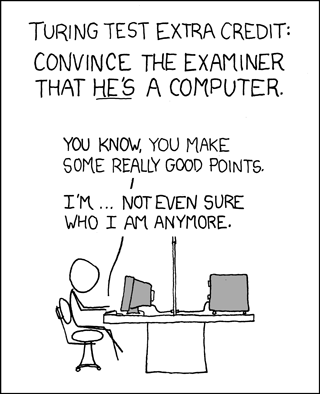
The turing test

[More from the philosophy book I read]

The turing test was a concept invented by Alan Turing, a brilliant mathematician in 1950. The Turing test was an AI test that sought to find a discrete event after which one could assume to have found artificial intelligence.

A proposed proof of this theory was the imitation game, by which a person interacted with other people, and at least one computer, and had to discover which one of them was the computer. The idea is that if a regular person wasn't able to tell which of the participants was the computer, then the Turing test would be passed for that AI.

More fundamentally, the Turing test is understood as one attempt to answer the more general question of whether a computer could be able to think and learn like a human. In other words, if such a thing as Artificial Intelligence is possible.

There have been many attempts to pass the Turing test, although so far they've all been unsuccesful. They are referred generally by the name of the software used to emulate the human. Some examples are "Parry", that attempted to emulate a paranoid schizophrenic, "Eliza", that used keywords in the input to return meaningful answers, and more recently "Alice".

Philosopher John Searle posed a challenge to the Turing test saying that computers are essentially sintactic and that it could be possible to map every possible combination of words to other meaningful combination of words. However, that still doesn't prove that the computer can understand semantics (meaning) and thus the test fails to demostrate whether AI can be achieved or not.

There is currently a yearly contest (the Loebner Prize) for the computer that manages to do best at imitating human conversation. The current winner (2008 at last) is Elbot and you can chat with him here.

Also, you might wanna check out a recent benchmarks of computers pretending to be human and actual humans is found here: http://botprize.org/.

Sunday, December 7, 2008

Cartesian skepticism


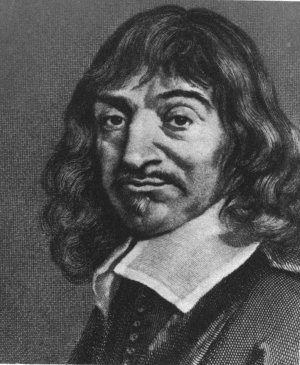
Descartes, in his seek for the kind of knowledge that cannot be denied and that we can safely use as a base for the development for more knowledge, created the method of reasoning onwards called cartesian skepticism.

"I will suppose... some malicious demon of the utmost power and cunning has employed all his energies in order to deceive me. I shall think that the sky, the air, the earth, colours, shapes, sounds and all external things are merely the delusions of dreams which he has devised to ensnare my judgement." René Descartes - Meditations on First Philosophy: First Meditation

The results of his skepticism is that he was only left with the sole knowledge of his own existence, hence his acclaimed phrase: cogito ergo sum (i think, therefore I am).

Unluckily for him, the limitations of his reasoning method didn't allow him to go any further. One kind of workaround he though of was the idea that anything that is so clearly true as our own consciousness must be true as well, and that the safekeeper of us not getting confused by the Demon (see quotation above), is God himself. I find it curious that God is thus taken as a foundation for the reconstruction of scientific knowledge.

One example of cartesian skepticism is the brain in a vat story.

Sunday, April 13, 2008

El modelo Google - Una revolución administrativa - Bernard Girard

Compré el libro "El modelo Google - Una revolución administrativa", de Bernard Girard. Tenía muchas ganas de leerlo, porque el libro de John Battelle, "The Search", me pareció muy bueno y me divirtió saber más de la empresa.

La verdad es que el libro me resultó interminable y aburridísimo. Es, en mi opinión, fruto de un periodista que se dedica a investigar algo de lo que no sabe. En el libro abundan las interpretaciones subjetivas de fenómenos de internet (como blogging, hacking, etc.) mal explicadas y vagamente contextualizadas, y en general me dió la impresión de que el autor posee una muy vaga comprensión de lo que sucede y la razón por la cual sucede.

Una cosa que me molesta mucho es cuando los autores (típicamente periodistas) se toman la licencia de hablar de lo que no saben, acudiendo a repetir lo que escucharon o leyeron, sin tener ninguna experiencia de campo ni estudios formales. Suelo encontrar estos casos en los que hablan de economía en la televisión. Da la impresión que creen que la realidad es tan simple y superficial como lo que escriben, y que basta con que suene bonito para convencer. La lógica no es requisito sine qua non de su discurso. La brevedad no es un valor.

Hay algunos puntos interesantes:
  • Google, según el autor, representa una revolución administrativa, así como lo fueron la revolución productivista de Ford, y la revolución de consumo masivo. Esto se basa en la multiplicidad de factores que hacen a la organización particular y que desafían el saber actual en management.
  • El triunvirato directivo (Larry, Sergei y Eric) tiene como ventaja que es más dificil que sean sujetos a presión ya que son tres tomadores de decisión. También es más fácil la reversibilidad de las decisiones, ya que la responsabilidad se diluye. Si bien inicialmente parece que un triunvirato quita libertad a sus partes, por estos dos efectos, parece también aumentarla.
  • La ausencia de patentes de invención, o la debilidad de su protección, parece aumentar el nivel de innovación, a diferencia de lo que se creería convencionalmente. Esto es debido a que cuando una empresa inventa algo, sabe que será imitada rápidamente, y no puede frenar para sacarle todo el provecho a esa tecnología, sino que debe seguir moviendose para perpetuar su ventaja.
  • Google utilizó el sistema de subasta Vickrey (sealed second bid) para su oferta pública. Este es el mismo sistema que para su sistema AdWords.
  • El modelo de negocio de Google, en donde sólo pagan los anunciantes, y nunca los navegantes, responde a una de las posibles configuración de lo que es conocido como mercado bilateral. Estos mercados son aquellos donde ambas partes deben conectarse y utilizan un tercero. Es el caso de las tarjetas de crédito, los sitios de subastas online (eBay, MercadoLibre, etc.) y también los motores de búsqueda.
Definitivamente este libro no es para recomendar (además de carísimo! 60$).

Addenda: Acabo de ver un video del autor, promocionando su libro. Menciona todos los temas que toca el libro, pero aclara que se intenta explicar el por qué. Para mi, el libro no fué más que una descripción, y las veces en que se ha intentado dar una causa orígen, la misma fué bastante poco precisa.

Monday, March 24, 2008

Cúspide me fidelizó

Ayer compré un libro en Cúspide, de casualidad mientras estaba en Recoleta. Lo interesante del hecho es que me ví gratamente sorprendido por el hecho de que pude transferir sin costo y sin problema mis puntos de la tarjeta Cúspide Max a la de mi novia.

Quiero destacar esto porque es algo que claramente ninguna librería está obligada a hacer, y de hecho reduce la rentabilidad del programa en el corto plazo, porque permite que se sumen puntos de varias tarjetas para comprar un libro.

Me parece claro que en esta ocasión, Cúspide puso a sus lectores primero, y se tomó el trabajo de establecer tanto su sistema como un procedimiento administrativo para que esto sea posible.

Este tipo de actitudes empresariales no abundan y valen la pena rescatar.
Por esta misma razón he decidido no comprar más en otras cadenas y siempre hacerlo en Cúspide :).
Quizás sea curioso notar que no fué la tarjeta al final la que me fidelizó, sino otro elemento totalmente diferente que muy seguramente nadie pensó que tendría ese efecto.
Ojalá sea cada vez más común!

Cómo tener buenas relaciones con los demás - Christian Zaczyk


En Diciembre compré un libro que se llama "Cómo tener buenas relaciones con los demás", de Christian Zaczyk. He decidido leerlo y resumirlo y aquí abajo presento algunas secciones interesantes.

El libro es muy interesante y tiene un correcto balance entre teoría y práctica, lo cual lo hace interesante para quien quiera tips prácticos sobre cómo lidiar con una situación dificil a su vez de entender de dónde estos proceden.

====
  • Perfil de respuesta al conflicto: Todos tenemos un perfil de respuesta a un conflicto, que consta de tres elementos: sentimientos, emociones y acción.

    Esto conforma una tipología de perfiles que, por nombrar algunos, son: agresivo, histérico, narcicista, impulsivo, falsamente tranquilo, víctima, paranoico, etc.

    Lo importante al respecto de los perfiles es que son relativamente estables en una persona, por lo que su identificación es un paso hacia adelante en hacerlos concientes y modificarlos.

  • Anticipaciones: Antes de una situación, siempre imaginamos un futuro posible. Esto es lo que el autor llama Anticipaciones, y la importancia de este concepto en este contexto es el de señalar que dichas anticipaciones condicionan grandemente nuestra aproximación a la situación futura, haciendo a veces que el conflicto sea más propenso a suceder de forma innecesaria.

    Christian Zaczyk sugiere que a través de la visualización conciente de nuestras anticipaciones, trabajemos para relativizarlas. Es importate recordar que las mismas no son más que hipótesis futuras pero que nuestro cerebro no puede diferenciar entre una situación imaginada y una real, y desata los mecanismos de defensa (y stress) por igual.

  • La Ira: El autor hace un interesante paréntesis al respecto de la ira desde un punto de vista médico.

    La ira se caracteriza por enrojecimiento, aceleración del ritmo cardíaco y tensión arterial.
    Se trata de una excitación del cerebro primitivo, que puede ganar primacía por sobre el neocortex. El cerebro primitivo reacciona agresivamente (fight) o bien escapando (flee) de la situación. Lo interesante del caso es que luego de un brote de ira, el cerebro primitivo sigue excitado por horas y días luego del suceso, efectivamente reduciendo el umbral de resistencia a nuevos brotes de ira.

    Otro factor que reduce el umbral es el stress, que genera irritabilidad, y que en esencia poner al cerebro primitivo en alerta constante. A diferencia del brote de ira, la irritabilidad no tiene su supuesto beneficio catársico.

  • Manejo de Conflictos
    • Do´s
      • Buscar comprender y luego ser comprendido
      • Reformular la situación y pedir confirmación de comprensión
      • Demostrar empatía (más allá de entender el problema, entender los sentimientos y emociones asociados)
      • Aceptar las opiniones de los otros sin criticarlas
      • Retrasar la ira: si se avecina, buscar una excusa o razón para retirarse y volverlo a analizar más tarde
      • Involucrar a la otra parte en la búsqueda de la solución
      • Utilizar la técnica del murmullo para evitar una escalada simétrica
      • Utilizar las técnicas del disco rayado, niebla y edredón para críticas negativas injustificadas y así evitar una escalada
    • Don´ts
      • Herir la imagen y autoestima del otro
      • Entrar en escaladas simétricas
      • Seriamente entrar en discusiones bizantinas. Lo correcto es tomarlas como una oportunidad para interesarse por el otro y sus opiniones.
Dato Curioso: El autor tiene una página en MySpace! http://www.myspace.com/christianzaczyk