 [More from the philosophy book I read]
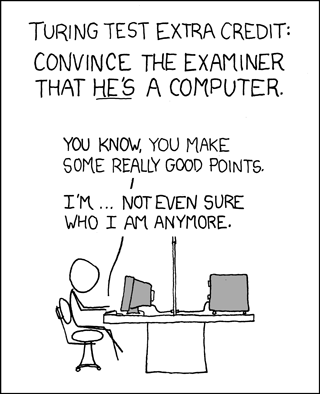
The turing test was a concept invented by Alan Turing, a brilliant mathematician in 1950. The Turing test was an AI test that sought to find a discrete event after which one could assume to have found artificial intelligence.
A proposed proof of this theory was the imitation game, by which a person interacted with other people, and at least one computer, and had to discover which one of them was the computer. The idea is that if a regular person wasn't able to tell which of the participants was the computer, then the Turing test would be passed for that AI.
More fundamentally, the Turing test is understood as one attempt to answer the more general question of whether a computer could be able to think and learn like a human. In other words, if such a thing as Artificial Intelligence is possible.
There have been many attempts to pass the Turing test, although so far they've all been unsuccesful. They are referred generally by the name of the software used to emulate the human. Some examples are "Parry", that attempted to emulate a paranoid schizophrenic, "Eliza", that used keywords in the input to return meaningful answers, and more recently "Alice".
Philosopher John Searle posed a challenge to the Turing test saying that computers are essentially sintactic and that it could be possible to map every possible combination of words to other meaningful combination of words. However, that still doesn't prove that the computer can understand semantics (meaning) and thus the test fails to demostrate whether AI can be achieved or not.
Also, you might wanna check out a recent benchmarks of computers pretending to be human and actual humans is found here: http://botprize.org/.
More fundamentally, the Turing test is understood as one attempt to answer the more general question of whether a computer could be able to think and learn like a human. In other words, if such a thing as Artificial Intelligence is possible.
There have been many attempts to pass the Turing test, although so far they've all been unsuccesful. They are referred generally by the name of the software used to emulate the human. Some examples are "Parry", that attempted to emulate a paranoid schizophrenic, "Eliza", that used keywords in the input to return meaningful answers, and more recently "Alice".
Philosopher John Searle posed a challenge to the Turing test saying that computers are essentially sintactic and that it could be possible to map every possible combination of words to other meaningful combination of words. However, that still doesn't prove that the computer can understand semantics (meaning) and thus the test fails to demostrate whether AI can be achieved or not.
There is currently a yearly contest (the Loebner Prize) for the computer that manages to do best at imitating human conversation. The current winner (2008 at last) is Elbot and you can chat with him here.
Also, you might wanna check out a recent benchmarks of computers pretending to be human and actual humans is found here: http://botprize.org/.
